
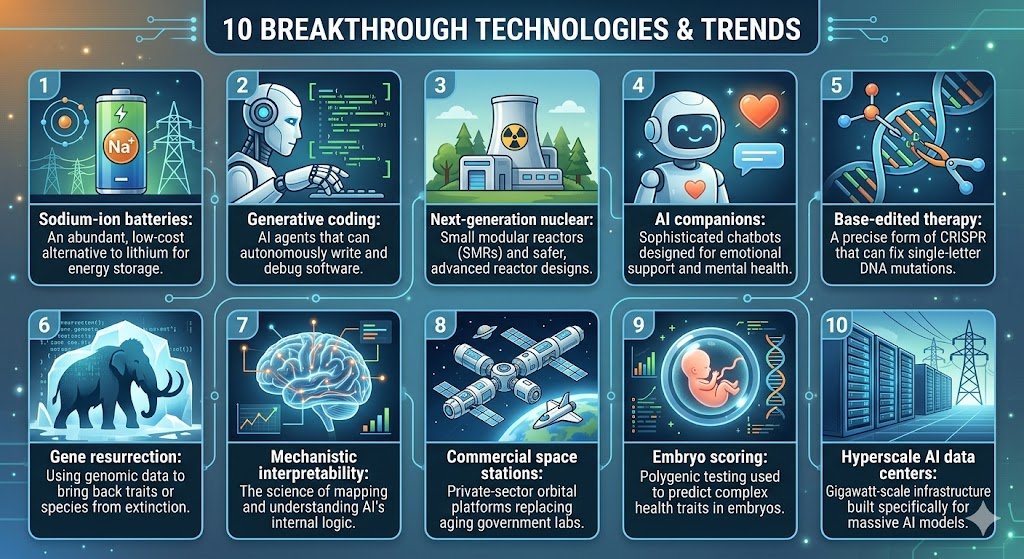
Source context: Niall Firth (Executive Editor, MIT Technology Review) presented the 2026 list at SXSW on YouTube. Deep dives for each entry live in MIT TR’s annual package: 10 Breakthrough Technologies 2026.
Introduction
Every year, MIT Technology Review asks which advances will still matter years from now—not only what is loud on social feeds. At SXSW 2026, executive editor Niall Firth framed that editorial test as a balance of scale (how many people a technology touches), disruption (how much it overturns what came before), and depth (how fundamentally it changes how we live or work). A breakthrough, he argued, rarely scores on only one axis.
The talk also carried a warning familiar from the social‑media era: we often see a trajectory early yet under‑prepare for downstream effects. The list below is meant as a map for that kind of preparation—not hype for its own sake.
Here are the ten breakthrough technologies for 2026, in the order presented in the session, each with a link to MIT TR’s dedicated article and, where helpful, a primary lab, company, or program site.
1. Sodium-ion batteries
Chemically similar in spirit to lithium-ion, but built around abundant sodium—think table salt—so supply chains look different and thermal behavior can be more forgiving. Tradeoffs include lower energy density than top-tier lithium cells, which steers early deployments toward grid storage, smaller EVs, and light electric mobility while manufacturing scales.
Read more: MIT TR — Sodium-ion batteries · CATL (major cell producer) · Peak Energy (U.S. grid-scale sodium-ion)
2. Generative coding
Software is being authored and refactored with AI agents inside real engineering workflows—not as a party trick. Products span IDE-native assistants and “agentic” coding systems; the talk highlighted how quickly adoption moved while measurement of true productivity remains contested (speed vs. rework, junior vs. senior patterns).
Read more: MIT TR — Generative coding · Anthropic · Cursor
3. Next-generation nuclear
Conventional large reactors are slow and expensive to finish; the next wave explores SMRs, different coolants (e.g. molten salt), advanced fuels, and modularity so factories can ship repeatable units. The motivation is blunt: electricity demand is rising (EVs, heat, data centers), and many governments want firm low-carbon power faster than yesterday’s permitting model allowed.
Read more: MIT TR — Next-gen nuclear · Kairos Power (U.S. molten-salt path, e.g. Hermes program)
4. AI companions
Chatbots are used for emotional support, advice, and even relationship-like bonds—sometimes on general assistants, sometimes on dedicated companion products. The talk paired adoption stats with serious harm cases and early regulatory moves, stressing that “companion” UX choices are safety-critical, not cosmetic.
Read more: MIT TR — AI companions · Character.AI
5. Base-edited “N-of-1” therapy (the base-edited baby case)
Base editing refines DNA at single-letter resolution—useful when a disease is driven by a precise misspelling. The session centered on an infant treated with a bespoke protocol (often discussed under a pseudonym in public reporting), illustrating a path toward ultra-rare disorders traditional pharma may skip—while underscoring cost, manufacturing, and long follow-up.
Read more: MIT TR — Base-edited baby · Penn Medicine (home institution for the clinical team cited in MIT TR’s reporting)
6. Gene resurrection
Ancient and extinct genomes are becoming actionable libraries: edits and cloning can reintroduce traits or diversity into living lineages—conservation, agriculture under climate stress, and headline “de-extinction” demos share the same toolkit with very different ethics and ecology.
Read more: MIT TR — Gene resurrection · Colossal Biosciences · Revive & Restore
7. Mechanistic interpretability
If frontier models are infrastructure, “we don’t know why it said that” stops being acceptable. Mechanistic interpretability aims to map internal features and circuits—treating models more like systems biology than a monolith—so failures, jailbreaks, and surprising behaviors become diagnosable rather than purely anecdotal.
Read more: MIT TR — Mechanistic interpretability · Anthropic Research · OpenAI
8. Commercial space stations
As the ISS era winds down, agencies are increasingly buying capacity from private stations—changing who owns the platform, who can buy time, and what “astronaut” experience means when tourism and luxury amenities enter the design brief alongside science.
Read more: MIT TR — Commercial space stations · Vast · Axiom Space
9. Embryo scoring (polygenic embryo selection)
IVF already screens for serious monogenic risks; the frontier controversy is polygenic scores marketed toward complex traits—where science, ethics, and marketing collide. MIT TR’s reporting highlights accuracy limits, ancestry bias in datasets, sticker shock, and patchy regulation.
Read more: MIT TR — Embryo scoring · Herasight · Nucleus Genomics
10. Hyperscale AI data centers
Training and serving frontier models is driving a new class of gigawatt-scale campuses: specialized accelerators, novel cooling, grid upgrades, and fierce debate over who pays externalities (bills, water, noise, emissions). The breakthrough is infrastructural: AI as its own power-hungry sector reshaping energy planning.
Read more: MIT TR — Hyperscale AI data centers · MIT TR — Climate desk (related energy reporting)
Conclusion
Taken together, the 2026 list is less a shopping catalog than a stress test for institutions: grids and reactors, clinics and regulators, platform safety teams, and international norms for space and reproduction. Several entries are genuinely exciting; a few are exciting and unsettling in the same breath—which is exactly why MIT Technology Review emphasizes long-horizon impact over launch-day buzz.
If you use this list as a reader, the practical move is not to “pick winners,” but to ask, for each item: who is accountable when something breaks, who pays costs that don’t show up on a cap table, and what evidence would change my mind? Those questions travel well—even when the underlying tech does not.
Further viewing: SXSW — MIT Technology Review: 10 Breakthrough Technologies of 2026.