
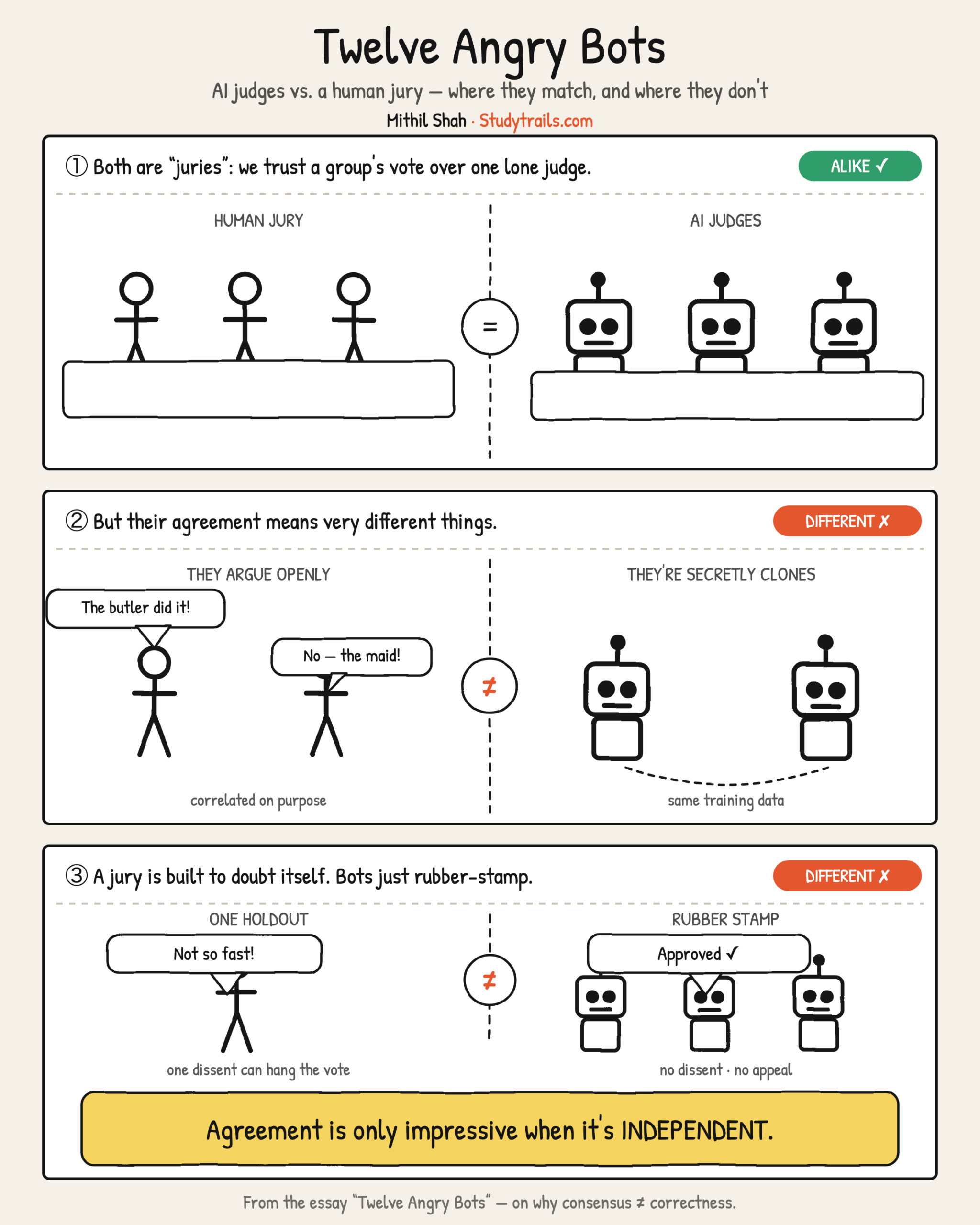
We’ve been building a brand-new kind of jury lately, and almost nobody has noticed. It doesn’t sit in a wooden box or complain about parking. It’s a panel of AI models, and its job is to deliver verdicts — Is this answer helpful? Is this comment toxic? Is this summary any good? We line up several AIs, let them vote, and trust the majority. More voters, more confidence. Sound familiar? It should. We basically reinvented the jury, gave it a Wi-Fi connection, and hoped nobody would ask the awkward questions courtrooms have been asking for two thousand years.
A recent Amazon Science article (When LLM Judges Agree, Should We Believe Them?) asks exactly one of those awkward questions. And the punchline is that our shiny robot jury has the same ancient flaw as the human one — it just hides it better.
The idea both systems are built on
Why do we trust twelve jurors more than one judge? Same reason we trust eight AI models more than one: the crowd is wiser than the individual — as long as each member thinks for themselves. That last part is the whole ballgame. A jury of twelve people who reason independently is powerful. A jury of twelve people who all copied the same guy is just that one guy wearing twelve hats.
Both the courtroom and the AI lab are standing on this single assumption: the voters are independent. Everything falls apart the moment they’re not.
Where the robot jury quietly cheats
Here’s the Amazon team’s uncomfortable finding: when a panel of AI models agrees, it might not mean they’re right — it might just mean they went to the same school.
These models are trained on the same mountains of internet text and fed nearly identical instructions. So when all eight nod along, it’s less “eight independent experts reached the same conclusion” and more “eight kids copied the same Wikipedia page for the group project.” If that page was wrong, you don’t get eight opinions — you get one mistake, photocopied eight times, wearing a confident smile.
Picture asking eight friends where to eat and all eight instantly yell “Olive Garden!” Impressive — until you learn they’re all siblings raised in the same house on the same nightly breadsticks. Their agreement suddenly says a lot about their upbringing and nothing about the restaurant.
The researchers’ fix is a mathematical sniff test for suspicious agreement: figure out which AI judges are just echoing each other, and turn down the volume on the copycats so the vote reflects real diversity instead of clones high-fiving. It works — their verdicts got measurably more accurate.
Where the human jury already knew the trick
Now for the part that ties the two together across two millennia.
The AI insight is “too much agreement is suspicious.” Ancient courts were already there. Under old Jewish law, if a serious case came before the judges and every single one voted “guilty” — total unanimity, not one dissent — the accused walked free. Why on earth?
Because the judges figured that if literally nobody saw a sliver of doubt, the process must be broken. Either everyone was pressured into going along, or nobody bothered to argue the other side. Perfect agreement wasn’t proof of guilt — it was a smoke alarm. That’s the exact instinct the Amazon researchers rebuilt with statistics: a verdict so unanimous it loops back around to “…okay, that’s a little too tidy.”
The twist: one jury talks, the other only pretends not to
Here’s the sharpest point of contact — and contrast — between the two.
A human jury is supposed to influence each other. They sit in a room and argue, persuade, and fight over the last slice of pizza. They’re deliberately correlated, because the whole point is to hash it out loud. We know they lean on each other, and we’re fine with it.
An AI jury is the opposite. We put each model in its own isolation booth specifically so it won’t copy the others — and then we assume it didn’t. The Amazon research catches them copying anyway. Not by whispering across the booth, but because they were all raised on the same data. It’s less Twelve Angry Men and more Twelve Suspiciously Agreeable Clones Who Never Met But Somehow Finish Each Other’s Sentences.
So the two juries relate like this:
- Human jury: openly correlated (they talk it out), and we account for it.
- AI jury: secretly correlated (same upbringing), and we get fooled by it.
Same flaw. One wears it on its sleeve; the other hides it in the training data.
So why do we still trust juries?
Fair question. If a jury has the same copy-each-other’s-homework flaw, why hand it life-and-death decisions? Here’s the beautiful part: the legal system never assumed jurors were independent. It gave up on that fantasy centuries ago and built an obstacle course around it instead. That’s the whole difference. The courtroom stopped pretending; the AI lab is still pretending.
What the robots could steal from the courtroom
Everything the Amazon team invented — the “sniff test for correlated judges” — is really just step one of a playbook lawyers wrote a very long time ago. Here’s the rest of it, translated for AI builders:
- Force two opposite arguments into the room. This is the big one. Every AI judge gets the same prompt — which is like running a trial where only the prosecutor is allowed to speak, then acting shocked everyone voted “guilty.” A real trial requires both sides to argue hard. Want less groupthink? Make some of your models argue for the answer and some against it, then judge the fight.
- Screen your panel before it votes. Courts interrogate jurors and boot the biased ones before the trial starts (it’s called voir dire, and yes, it’s as fun as it sounds). The AI version: actually check whether your models are near-clones before you trust their consensus, instead of after.
- Give the lone holdout real power. One stubborn juror can hang an entire verdict, which forces the majority to persuade rather than steamroll. AI panels just tally votes in silence, so a lazy consensus costs nothing. Build in a step where a dissenting model gets to push back and make the others defend themselves.
- Control what they’re fed. Rules of evidence exist so jurors aren’t all poisoned by the same rumor. If every model is marinating in the same slice of the internet, don’t be surprised when they share the same weird opinions. Diversify the diet.
- Decide which mistake you’d rather make. “Beyond a reasonable doubt” deliberately tilts the system toward letting the guilty go free rather than jailing the innocent — because one error is worse than the other. Your AI judge should know which direction to be cautious in too. Being wrong isn’t one thing; pick your poison on purpose.
- Keep an appeals button. Juries can be overruled, retried, and second-guessed, because everyone accepts they sometimes blow it. Most AI panels treat the vote as the final word. Leave room to say “run that one by a human.”
And the deepest lesson of all: the jury doesn’t really survive by being the most accurate machine imaginable — nobody’s proven it is. It survives because it delivers something a rack of servers can’t: a verdict people will actually accept as fair. The courtroom quietly traded a little accuracy for legitimacy. The robots are chasing only accuracy — which is exactly why the correlation flaw stings them so much more.
The verdict both juries hand down
Strip away the robes and the server racks, and the AI judge and the human jury are teaching the identical lesson:
Agreement is only impressive when it’s independent.
Ten people telling you the same thing is powerful — unless they all heard it from the same guy at the same bar. Then it’s not evidence. It’s gossip with extra steps.
So the next time an AI proudly announces “all our models agree,” do what a wise old juror would do. Raise one eyebrow, and ask the only question that has ever mattered in any jury room, human or otherwise:
“Did you each actually think for yourselves — or did you just copy each other’s breadsticks?”