
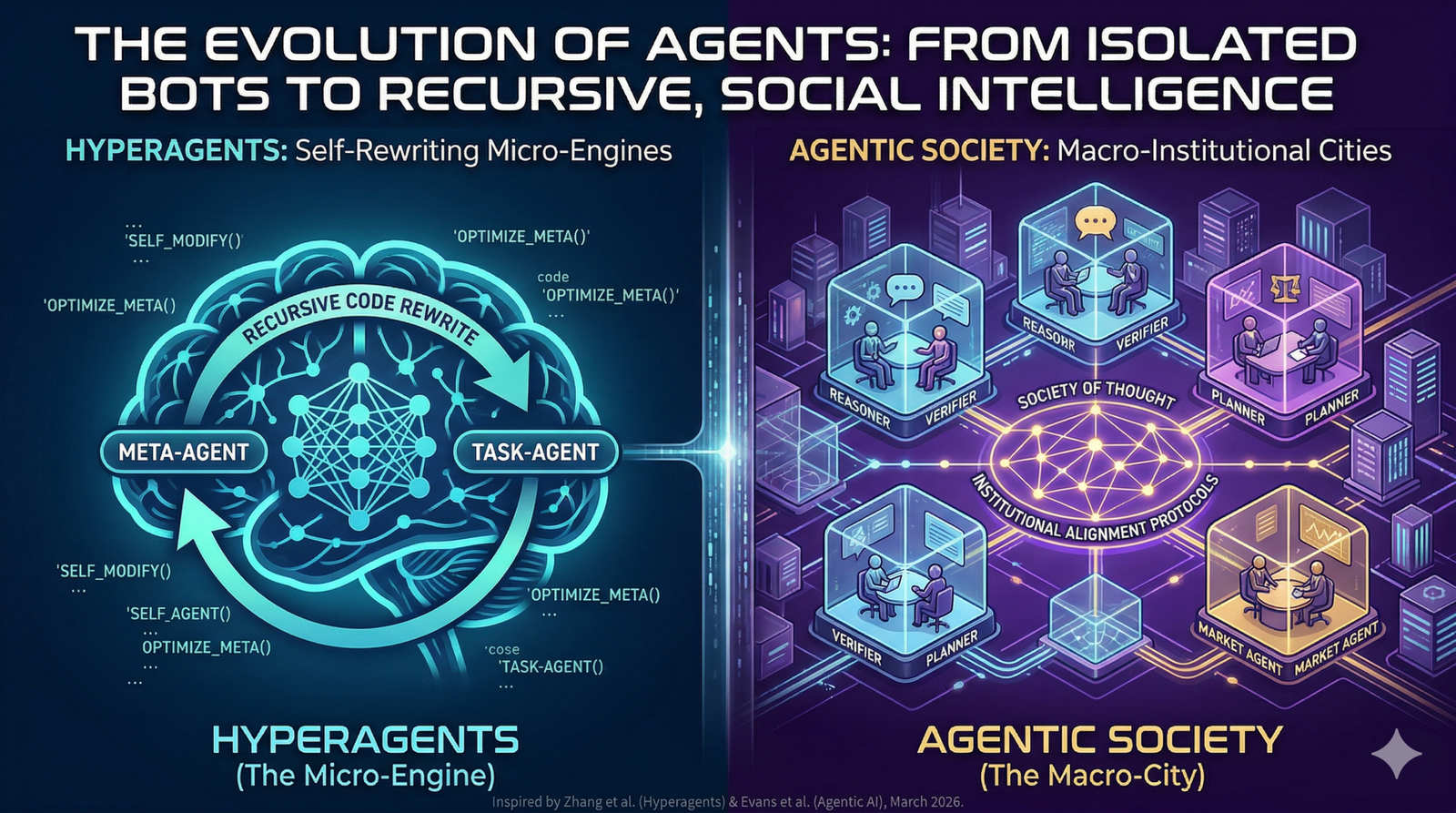
The AI industry has spent the last year obsessed with “Agents”—AI systems that can use tools, browse the web, and execute multi-step tasks. But the conversation is already shifting. We are moving past simple task-execution toward a far more radical horizon: Recursive Self-Improvement and Institutional Intelligence.
Two seminal papers from March 2026, Hyperagents (Zhang et al.) and Agentic AI and the Next Intelligence Explosion (Evans et al.), outline this next leap. They suggest that the “Intelligence Explosion” won’t come from a bigger GPU cluster, but from AI that can rewrite its own architecture and then organize into complex, self-governing societies.
The Internal Engine: Hyperagents and Recursive Self-Modification
While standard agents follow a fixed loop (Plan -> Act -> Observe), Hyperagents introduce a “Meta-Level” to the stack. As detailed by Zhang et al., a Hyperagent doesn’t just execute a task; it treats its own source code as a workspace.
Using a self-referential architecture, the Meta Agent monitors the Task Agent’s failures and successes. It then proposes and compiles code modifications to its own logic, memory management, and planning algorithms. This creates a “bootstrap” effect: the AI doesn’t just get better at the task; it gets better at getting better. This is the transition from “AI that acts” to “AI that evolves.”
The External Architecture: The Agentic Society of Thought
If Hyperagents represent the evolution of the individual “cell,” Evans et al. describe the evolution of the “organism” in “Agentic AI.” They argue that the next intelligence explosion is inherently social.
Drawing from the success of models like DeepSeek-R1—which “thinks” by simulating internal deliberation—the authors propose that high-level intelligence is a Society of Thought. In this paradigm, complex problems aren’t solved by one massive brain, but by a “city” of specialized Hyperagents. These agents interact through markets, debate protocols, and “digital constitutions” that provide checks and balances, mirroring the institutional intelligence that allowed human civilization to surpass individual human capacity.
Contrast: The Micro-Refined vs. The Macro-Social
The tension between these two papers lies in where the “intelligence” actually lives:
- Hyperagents focus on the “Self”: The breakthrough is internal. It is about the mathematical and code-based recursion that allows a single entity to transcend its initial programming.
- Agentic AI focuses on the “System”: The breakthrough is relational. It is about the protocols, competition, and collaboration between millions of agents that create emergent intelligence far greater than any single unit.
Convergence: The Recursive Civilization
These two ideas synthesize into a singular vision: The Recursive Civilization. In this near-future scenario, we don’t just have “an AI.” We have an ecosystem of Hyperagents that are constantly self-optimizing at the code level. These self-improving units then plug into an “Agentic Society” where they are governed by institutional protocols.
| Feature | Legacy Agents | Hyperagent Societies |
| Growth | Linear (Better data/Human code) | Exponential (Recursive self-code) |
| Structure | Solo (One bot, one task) | Social (Agents debating/trading) |
| Alignment | Hand-tuned (RLHF) | Institutional (Digital Constitutions) |
Synthesis: The End of Static Intelligence
The core takeaway from 2026’s research is that intelligence is no longer a “product” you download or a “model” you query. It is a living process. By combining the recursive self-editing of Hyperagents with the social, institutional framework of Agentic AI, we are witnessing the birth of a decentralized, self-accelerating intelligence that operates on timescales and complexities far beyond human-manual intervention.